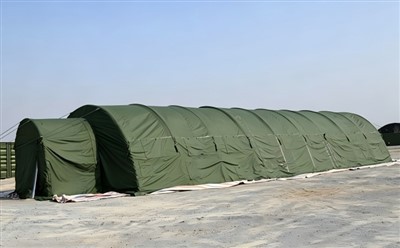

From record-breaking spans to stark height changes, air-supported membrane structures are quietly re writing what counts as "possible" in today's building work. At a recent national forum on spatial structure engineering, a technical report got a lot of attention, mainly because it described how newer air-supported approaches tackled two of the hardest problems in the field. The conversation basically showed how an Inflatable Tent idea can move way past short-term, temporary use, and then into bigger, industrial scale plans where things are more demanding.

The report leaned heavily on practical engineering when the terrain is harsh and the climate is even harsher. In one case, there was a big material storage enclosure, in a northern region, where a single-span layout stretched to 200 meters. That became a domestic first, for air-supported systems at anything near that magnitude. Engineers used computational fluid dynamics simulations to adjust the surface profile, with the goal of lowering wind stress, and they kept iterating until the shape looked stable. For colder periods, they relied on low-temperature-resistant membrane materials, so the structure stayed safe even down to –40°C, and the Inflatable Tent system could keep running continuously, without getting damaged.

A second case came out of a mining project in southern terrain, featuring a 42.5-meter height difference across the site. Honestly, those elevation gaps aren't common for air-supported construction, and they raise the execution risk a lot. The team handled it with digital simulation, where they mapped lifting paths and organized construction steps, in a way that made the whole sequence feel more controlled. Modular installation, plus heavy-duty cranes, improved the overall pace by 50 percent, and it also proved that an Inflatable Tent method can be adapted for steep and uneven landscapes, even when conditions don't exactly cooperate.

Operational safety and, uh long term reliability were also key themes. To handle long-standing concerns such as membrane collapse and high maintenance costs, engineers came up with a set of integrated solutions. High-strength polymer fiber cables replaced the traditional steel components, and that helped weather resistance by roughly 30 percent, give or take. At the same time, a cloud based management platform enabled real-time monitoring and early warnings, so stable performance stayed on track for each Inflatable Tent deployment.
From design through construction, strict quality control actually became the central factor. A full lifecycle management system was established, to oversee every stage- starting from the initial modeling then moving into on site installation. This systematic approach reduced uncertainty, and also improved construction accuracy, which was especially important when dealing with ultra-large spans and complex terrain. So, in the end, the Inflatable Tent structure maintained structural integrity along with operational safety throughout the entire project.
Industry experts pointed out that ultra-large spans and big terrain differences have long been treated like "no-go zones" for air-supported structures. The successful implementation of these projects basically signals a major step forward in environmental adaptability and precision control. With patented technologies now in place, the Inflatable Tent model is evolving into a safer greener, and more efficient solution for industrial and environmental applications. This is paving the way for broader adoption in the future.