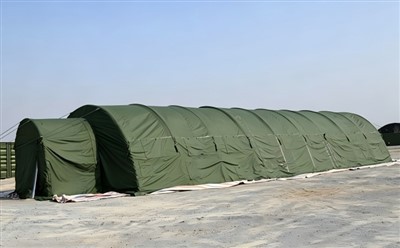

The materials generally used for disaster relief tents are Oxford cloth and PVC coated cloth. These two materials are durable and wear-resistant, and can also be waterproof and UV-resistant. The material of the inflatable column is PVC double-sided coated cloth. Such tents are generally moisture-proof, mildew-proof, high-strength, and fast to form. The brackets are all metal brackets, so that they can be sufficient for use in the disaster relief process.
First take out 8 universal rods and three sets of end frame tees and middle frame four-way, and tighten and fix them with wire ropes to form three sets of herringbone connections. Take 4 universal rods, end frame tees and middle frame tees to form a frame.
Then put the entire cotton liner on the three sets of herringbone frames, adjust the position so that the top of the cotton liner is aligned with the middle rod of the herringbone frame. Place the top cover of the outer cover outside the cotton lining of the three sets of herringbone frames and adjust the position.
Take 6 columns, insert the end frame tees and the middle frame four-way respectively, and use 6 people to support the canopy roof, and connect the columns with the placed ground poles through the poles. The side walls of the cotton liner and the gables of the cotton liner are bonded with nylon fasteners, and the position is adjustable.
The straps on each column of the single tent body pass through the copper tent ring of the cotton liner and are tied to each column. Tighten each part, fasten the nylon zipper, adjust the position of the tent, and connect it to the frame poles. The side walls and gables of the liner of the ground tent are bonded together with nylon fasteners.
Drive the triangular pile into the corresponding position of the ground, fix the pull rope, adjust the tightness, and put the rubber-plastic pile on the end face of the triangular pile. Pack up the tent and bury it along the perimeter of the tent.