
Standard and testing of flame-retardant fabrics
Classification of flame retardant fabrics
The currently used flame-retardant fabric products mainly include flame-retardant fabrics and flame-retardant carpets. The main raw materials for flame-retardant fabrics are cotton, polyester, wool, etc. There are two types of flame-retardant fabric products used according to different processing methods: pre treated and post treated flame-retardant fabrics.
Some manufacturers also refer to pre treated flame-retardant fabrics as permanently flame-retardant fabrics. Pre treated flame-retardant fabrics can be understood as adding flame retardants to produce flame-retardant fibers before producing the fabric, then producing flame-retardant yarns, and finally weaving to produce flame-retardant fabrics. The advantage of flame retardant fabric pre-treatment is that it has a soft touch and a long service life, making it an environmentally friendly product. The disadvantage is that compared with post-processing fabrics, there are fewer manufacturers, so the existing products have fewer colors and patterns, which makes it inconvenient to meet customers' personalized needs. It is necessary to customize according to customers' orders to the manufacturer, and the production cycle is about two months, which is expensive.
Post processed flame-retardant fabrics refer to flame-retardant fabrics produced by soaking or coating with flame-retardant chemicals after the production of ordinary fabrics. The advantage of post-treatment flame retardant fabric is that it has a wide variety of fabric patterns and colors, which can meet the personalized needs of customers. The production cycle is short and the price is lower than that of pre-treatment flame retardant fabric. But its hand feel is relatively hard, and its flame retardant performance decreases after washing. To maintain its flame retardant performance, it needs to be reprocessed.
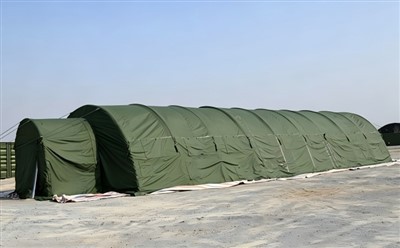
The flame-retardant fabrics used in tents are mostly post treated flame-retardant fabrics.
Grades and standards of flame-retardant fabrics:
Different countries have established different standards for the flame retardant performance of fabrics. Taking China as an example, flame retardant fabrics are usually classified into the following levels based on their different flame retardant properties:
B1 level: Flame retardant building material with good flame retardancy. Under the action of an open flame, it is difficult to ignite, ignite slightly, or carbonize. Once the fire source is removed, combustion or slight ignition immediately stops.
B2 level: Flammable building material with certain flame retardant properties. Under the action of an open flame, it immediately ignites and burns, but can still continue to burn after the fire source is removed.
B3 level: Flammable building material, with no flame retardant effect, extremely flammable, and high fire hazard.
The evaluation of the flame retardant performance of materials generally includes the following indicators:
(1) Ignite difficulty.
(2) Flame surface propagation speed.
(3) Smoke visibility.
(4) Toxicity of combustion products.
(5) The corrosiveness of combustion products.
Determination of flame retardancy of textiles
Vertical combustion test, reference standard: GB/T 5455-1997, reference standard: GB 6529-86
Under the specified experimental conditions, the flame is directly applied to the lower end of the vertically suspended sample, and the maximum damage length, continuation time, and smoldering time of the fabric after combustion are measured.
The national B1 standard is: damage length ≤ 150mm, ignition time ≤ 5s, and smoldering time ≤ 5s.
The national B2 standard is: damage length ≤ 200mm, ignition time ≤ 15s, and smoldering time ≤ 10s.
Our high pressure inflatable tents, low pressure inflatable tents, rescue tents, and military tents,can undergo flame retardant testing according to different national standards for their tarpaulins, air column fabrics, and accessories based on customer needs.