

In the high - stakes world of military operations, a Military Command Post (MCP) serves as the nerve center for decision - making and strategic coordination. It is a critical hub that must be able to withstand and respond to enemy attacks effectively. As a provider of essential equipment for Military Command Posts, I have witnessed firsthand the challenges and solutions in dealing with such threats.
Understanding the Threat Landscape
Enemy attacks on a Military Command Post can take various forms, each with its own set of challenges. One of the most common threats is aerial bombardment. Modern warfare has seen the development of sophisticated aerial weapons, such as precision - guided missiles and bombs. These can be launched from a significant distance, making early detection and defense crucial. For example, during the Gulf War, many military command centers were targeted by Iraqi Scud missiles, which forced the coalition forces to develop effective counter - measures.
Another threat comes from ground - based attacks. Enemy forces may attempt to infiltrate the area around the command post, either through direct assault or by using guerrilla tactics. This requires a strong perimeter defense system to prevent unauthorized access. In addition, cyber - attacks have become an increasingly significant threat. Hackers may try to disrupt the communication and information systems of the command post, which could lead to a breakdown in the chain of command.
Detection and Early Warning
The first step in dealing with enemy attacks is to detect them as early as possible. This involves the use of a variety of sensors and surveillance systems. Radar systems are essential for detecting incoming aerial threats. They can provide information on the speed, altitude, and direction of approaching aircraft or missiles. For example, the Patriot missile defense system uses advanced radar technology to detect and track incoming threats, allowing for a timely response.
Infrared sensors can also be used to detect the heat signatures of enemy vehicles or personnel. These sensors are particularly useful for detecting ground - based threats, especially at night. In addition, acoustic sensors can detect the sound of approaching vehicles or gunfire, providing an additional layer of early warning.


Defensive Measures
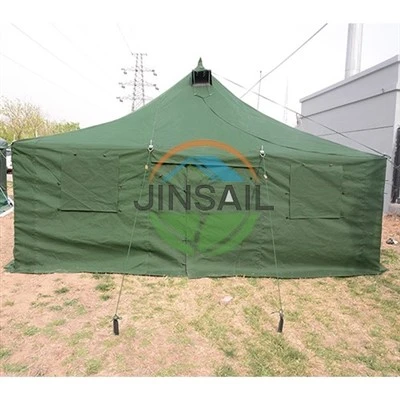
Once an enemy attack is detected, the Military Command Post must implement a series of defensive measures. One of the most important defensive measures is the use of protective shelters. Shelter Tents Military are designed to provide a safe and secure environment for the command post personnel. These tents are made of high - strength materials that can withstand the impact of shrapnel and other debris. They also provide protection against the elements, such as extreme heat or cold.
For smaller units, Squad Cotton Tent – Heavy Duty Field Canvas Shelter can be a practical option. These tents are lightweight and easy to set up, making them ideal for rapid deployment. They are also made of durable cotton canvas, which provides good protection against the elements.
In addition to shelters, the command post may also be equipped with anti - aircraft guns and missile defense systems. These systems are designed to shoot down incoming aircraft and missiles. For example, the Phalanx Close - In Weapon System is a rapid - fire gun that can be used to defend against low - flying aircraft and missiles.
Communication and Coordination
Effective communication and coordination are essential for dealing with enemy attacks. The command post must be able to communicate with other military units, such as air support, ground forces, and intelligence agencies. This requires a reliable communication system that can operate in a variety of environments.
Satellite communication systems are often used to provide long - range communication capabilities. These systems can transmit voice, data, and video over long distances, allowing for real - time information sharing. In addition, radio communication systems are used for short - range communication within the command post and between nearby military units.
Response and Counter - Attack
Once the command post has detected and defended against an enemy attack, it may need to launch a counter - attack. This requires careful planning and coordination. The command post must assess the situation and determine the best course of action.
If the enemy is a ground force, the command post may call in air support to conduct a bombing raid or use ground forces to launch a counter - offensive. If the enemy is using cyber - attacks, the command post may need to deploy cyber - security teams to defend the information systems and launch counter - attacks against the enemy's cyber infrastructure.
Adaptability and Flexibility
In the dynamic environment of military operations, the Military Command Post must be adaptable and flexible. It must be able to respond to changing threats and circumstances. For example, if the enemy changes their tactics, the command post must be able to adjust its defensive and offensive strategies accordingly.
This requires continuous training and development of the command post personnel. They must be familiar with the latest technologies and tactics, and be able to make quick decisions under pressure. In addition, the command post must be able to work effectively with other military units and agencies, both at home and abroad.
Conclusion
Dealing with enemy attacks on a Military Command Post is a complex and challenging task. It requires a combination of detection, defense, communication, and counter - attack capabilities. As a provider of equipment for Military Command Posts, we understand the importance of providing high - quality and reliable products. Our Usable area 37m² Metal Frame Grid Tent – Rapid - Deployment Military & Emergency Shelter and other products are designed to meet the needs of modern military operations.
If you are interested in purchasing equipment for your Military Command Post, we encourage you to contact us for further information and to discuss your specific requirements. We are committed to providing the best solutions for your military needs.
References
- Department of Defense, "Military Operations Manual", 2020.
- NATO, "Guide to Military Command and Control", 2019.