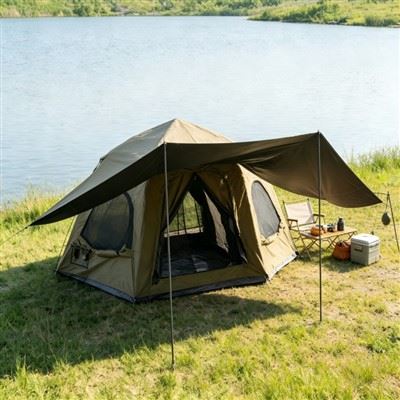


Products Description

A military vehicle-side tent is a specialized accessory designed for use with military vehicles-such as off-road vehicles, trucks, command vehicles, and the like.
Its defining characteristic is that it deploys directly from the side of the vehicle body. Unlike standard freestanding tents, it utilizes the vehicle itself as a structural support on one side; typically, it is secured to the vehicle's roof rack or body frame via sliding rails, latches, or straps. Once deployed, it creates a sheltered space-suitable for shade, accommodation, or operational tasks-that is seamlessly integrated with the vehicle body.
Main Types
Based on their structural design, military vehicleside tents can be categorized into the following types:
Folding/Retractable Vehicle-Side Tents
This is currently the most common type found on military off-road vehicles and command vehicles. The main body of the unit is typically stowed within a robust aluminum alloy casing mounted along the side of the roof rack. To deploy, one simply pulls out and extends the awning fabric while simultaneously extending a few collapsible support legs. Its key advantage lies in its extremely rapid setup and takedown-a single person can complete the process within minutes-making it ideally suited for reconnaissance, communications, or command vehicles that require frequent, brief stops and rapid deployment capabilities.


Inflatable Vehicle-Side Tents
Unlike traditional designs, this type of awning lacks a conventional metal framework; instead, it utilizes inflatable air ribs (or air columns) constructed from high-strength PVC material. To deploy, an electric or foot pump is used to inflate the air ribs, causing the entire awning to rapidly take shape much like an inflatable castle. Its core advantages lie in its simple structure, light weight, compact storage volume, and the excellent shock-absorbing properties provided by the air ribs. A patented "armored vehicle-mounted awning" design, for instance, employs this very structure; its air ribs abut directly against the vehicle body, thereby creating an enclosed space suitable for maintenance operations.
Frame-Supported Vehicle-Side Tents
This represents a more traditional structural approach, utilizing independent metal tubes (such as powder-coated steel or aluminum alloy tubing) to form a supporting framework. The tent fabric is draped over this frame and secured to the vehicle body via various connectors. This type of tent boasts the most robust and durable structure, capable of withstanding strong winds and heavy snow loads; consequently, it is typically deployed in field encampments, temporary command posts, or maintenance stations where long-term stationary operations are required.

Framed vs. Inflatable Vehicle Side Tent
If inflatable military vehicle-side tent are the light cavalry-prioritizing speed and rapid deployment-then frame-supported vehicle-mounted tents are the heavy-armored fortresses, prioritizing stability and steadfastness. By embracing structural "slowness" and "heaviness," they achieve unparalleled environmental adaptability, comprehensive protective capabilities, and maximum potential for functional expansion, serving as the bedrock for supporting large-scale military operations and long-term garrison missions.
Consequently, in modern military forces, inflatable and frame-supported vehicle-mounted tents are frequently deployed in tandem:
Inflatable tents are utilized to establish temporary staging points for rapidly advancing vanguard units, while frame-supported tents are subsequently erected in the rear to construct robust command and logistical support bases.
| Aspect |
frame-Supported
|
Inflatable
|
| Core Strength | Ultimate durability, comprehensive protection, strong scalability | Extremely rapid deployment, lightweight and portable, shock-absorbing |
| Setup Time | Slower, approx. 25 minutes with 4 people (requires assembling the frame) | Very fast, 3–8 minutes by a single person (inflate and deploy) |
| Wind Resistance | High (withstands winds of 8–10 Beaufort scale) | Moderately high (typically withstands winds up to Beaufort scale 8) |
| Snow Load Capacity | High (can bear up to 6 cm of accumulated snow) | Moderate (air beam structure has lower snow load capacity than metal frames) |
| NBC Protection | Easily integrated (can connect to vehicle's filtration system) | Available in some models (requires specialized design) |
| Scalability | Highest (multiple units can be connected indefinitely) | Moderate (connection possible, but limited by air beam structure) |
| Packed Volume | Large (frame and fabric packed separately) | Small (folds down to 1–2 backpack-sized packages) |
| Weight | Heavy (steel or aluminum alloy frame) | Light (fabric and a few accessories only) |
| Maintenance Cost | Low (durable frame, easy local repairs) | Relatively high (air beams vulnerable to punctures, require specialized repair) |
| Typical Applications | Long-term command posts, field hospitals, maintenance workshops | Rapid advance units, temporary forward camps, reconnaissance squads |
Functions and Applications
The design of military vehicle tents places a strong emphasis on functional specialization to meet diverse tactical requirements.
Accommodation Tents
This is the most common type, primarily used to provide resting and sleeping quarters for officers and enlisted personnel. To enhance comfort and adaptability to varying environmental conditions, modern military accommodation tents typically feature a double-layer structure: an outer layer provides protection against rain and sun, while an inner layer offers thermal insulation and heat retention, enabling the tents to adapt to climates ranging from frigid to tropical zones. For instance, the PLA once fielded a specific series of Type A and B accommodation tents designed to integrate with heavy-duty military trucks; capable of housing 20 personnel, these tents feature a setup mechanism tightly integrated with the vehicle, allowing the truck's folded-down cargo bed panels to serve directly as sleeping platforms once deployed
Combat/Command Tents
These tents serve as the military's "mobile nerve centers," offering not only spacious interiors but also integrating a wide array of functionalities. They are typically designed with a modular, combinable structure, allowing multiple smaller tent units to be rapidly linked together to form a large-scale command post. The tent interiors feature pre-allocated ports for routing communication lines, power cables, and ventilation ducts; furthermore, certain advanced models possess "three-defense" capabilities (protection against nuclear, chemical, and biological weapons) and can interface with a vehicle's filtration and ventilation systems to create a sealed, protected environment.
Maintenance/Support Tents
These tents are specifically designed for field equipment support operations, providing maintenance personnel with a relatively enclosed workspace shielded from adverse weather conditions. A prime example is the aforementioned inflatable armored vehicle maintenance tent, which deploys directly alongside a combat vehicle to create a temporary "workshop" for the emergency repair of critical components such as transmission and suspension systems
Multi-purpose/General-Use Tents
This category of tents prioritizes high versatility and scalability; a single basic unit can be flexibly reconfigured-via various connection methods-to serve as a mess hall, supply depot, medical station, or troop dormitory. This design significantly alleviates logistical burdens by reducing both the variety and total quantity of tents that a military unit needs to transport.
Why Choose JINSAIL TENT ?
JINSAIL is a professional military tent manufacturer , designs and manufactures high-performance military shelter systems trusted by global defense and emergency organizations. Provides durable, reliable, and cost-effective military shelter solutions for global clients.
20+ years experience in military tent manufacturing
Exported to 30+ countries
Reliable quality for government and defense procurement
Custom sizes and camouflage patterns available
OEM / ODM support
Factory direct supply with competitive pricing
Custom sizes and Materials
7x24 Hours Service Capacity
One-stop Solution Service
Fast Production & Global Delivery
Our Certifications

ISO45001

ISO9001

ISO14001

CE

UK CA

Export Rights
Hot Tags: military vehicle side tent, China military vehicle side tent manufacturers, suppliers, factory, canopy metal frame tent, tables for metal frame tent, uv resistant metal frame tent, collapsible metal frame tent, mosquito nets for metal frame tent, pegs for metal frame tent